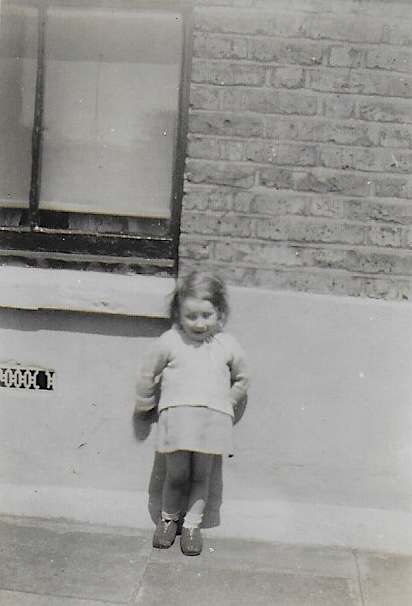
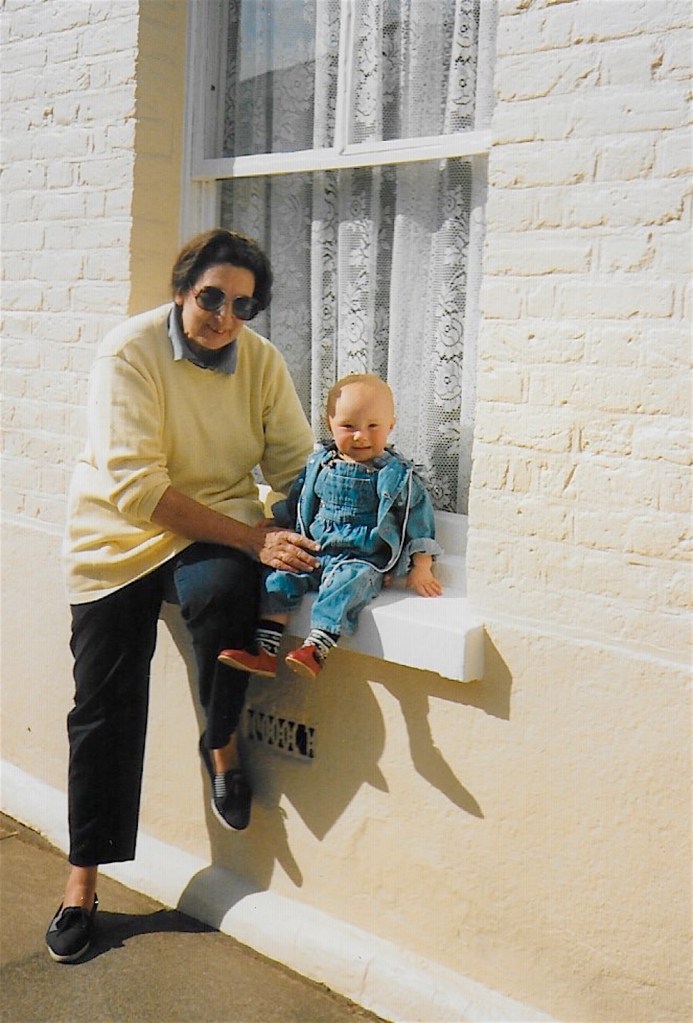
This article (reproduced here unedited) was first published in the Spring 2026 edition of Battersea Matters, the member magazine of The Battersea Society
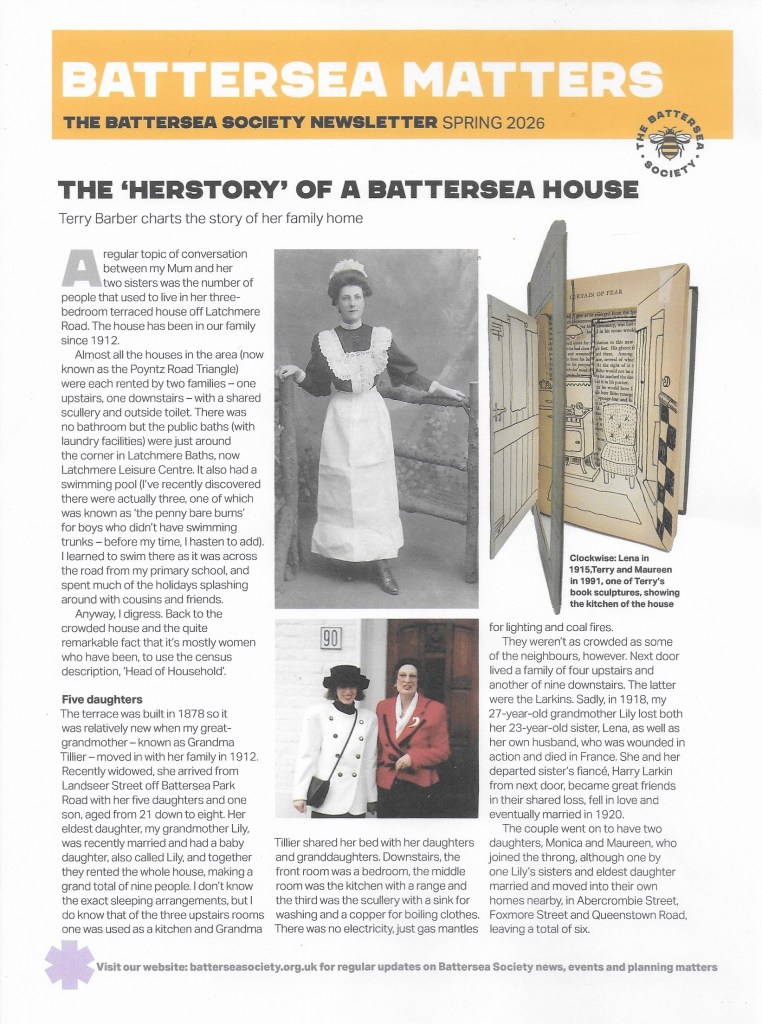
Terry Barber, the artist daughter of the Battersea Society’s former membership secretary, Maureen Larkin, has been charting the history of the house that’s been in her family since 1912, and has taken inspiration from it for her recent work.
A topic of conversation that cropped up regularly between my Mum and her two sisters was the number of people that used to live in her three-bedroom terraced house off Latchmere Road. Most (if not all) of the houses in the area (now known as the Poyntz Road Triangle) were each rented by two families – one upstairs, one downstairs – with a shared scullery and outside toilet. There was no bathroom but the public baths (with laundry facilities) were just around the corner in Latchmere Baths, now Latchmere Leisure Centre. It also had a swimming pool (I’ve recently discovered there were actually three, one of which was known as ‘the penny bare bums’ for boys who didn’t have swimming trunks – before my time, I hasten to add). I learned to swim there as it was across the road from my primary school, and spent much of the holidays splashing around with cousins and friends.
Anyway, I digress. Back to the crowded house and the quite remarkable fact that it’s mostly women who have been, to use the census description, ‘Head of Household’.
The terrace was built in 1878 so it was relatively new when my great-grandmother – known as Grandma Tillier – moved in with her family in 1911/12. Recently widowed, she arrived from Landseer Street off Battersea Park Road with her five daughters and one son, aged from 21 down to eight. Her eldest daughter, my grandmother Lily, was recently married and had a baby daughter, also called Lily, and together they rented the whole house, making a grand total of nine people. I don’t know the exact sleeping arrangements, but I do know that of the three upstairs rooms one was used as a kitchen and Grandma Tillier shared her bed with her daughters and granddaughters. Downstairs, the front room was a bedroom, the middle room was the kitchen with a range and the third was the scullery with a sink for washing and a copper for boiling clothes. There was no electricity, just gas mantles for lighting and coal fires.
They weren’t as crowded as some of the neighbours, however. Next door lived a family of four upstairs and another of nine downstairs. The latter were the Larkins. Sadly, in 1918, my 27-year-old grandmother Lily lost both her 23-year-old sister, Lena, as well as her own husband, who was wounded in action and died in France. She and her departed sister’s fiancé, Harry Larkin from next door, became great friends in their shared loss, fell in love and eventually married in 1920. The couple went on to have two daughters, Monica and Maureen, who joined the throng, although one by one Lily’s sisters and eldest daughter married and moved into their own homes nearby, in Abercrombie Street, Foxmore Street and Queenstown Road, leaving a total of six.
Trials and tribulations
Grandma Tillier paid her way with occasional ‘charring’ (cleaning), and also the ‘laying-out’ of local people who had recently died, while her two eldest daughters, Lily and Lena, went into service as parlour maids – jobs they were proud of as they were working ‘upstairs’. (A neighbour confided in me a few years ago that when he was a child, he used to call my grandmother ‘the posh lady’!). After her young husband was killed, Lily joined her younger sisters working at the Falcon pencil factory in York Road.
The trials and tribulations of a working-class family were kept very much to themselves, and certain events were rarely talked about, including unemployment; Grandma Tillier’s brother’s suicide over gambling debts; the commital of her only son from the workhouse infirmary to the ‘mental hospital’ in Epsom; and her own court appearance over rent arrears. Apparently, when she went to the authorities for help to pay the rent, they asked her if she had any furniture; when she answered ‘yes’, she was told to come back when she had sold it and had nothing left.
In 1930, Maureen’s father Harry, who was a shop assistant at Milton Syer builders merchants in Peckham, increased his and wife Lily’s rental from two rooms to three, paying nine shillings and sixpence per week. The third room was the upstairs front bedroom where my Mum, Maureen, was born. Grandma Tillier continued to live in her rented bedroom and kitchen until she died in 1948, followed a couple of months later by her son-in-law Harry. My grandmother went back to work again, helping a friend with housekeeping duties for a family in Burgess Hill. Monica and her husband Peter had a son later that year and moved into a house in Sabine Road, and Maureen left school, aged 15, to start work as a secretary to help pay the rent now it was just her and her Mum at home. Until I came along, that is, and then there were three. When my grandmother died in 1971, Maureen took over the rental and once I had started work she was able to buy the house in 1975 from the landlord – for the princely sum of £2,000. With a home improvement grant from the council we finally had the luxury of a bathroom and she continued to live there for the rest of her life.
With such a long family history it would have been difficult to let the house go when Mum died, but luckily my own daughter, Madeleine, felt the same way and is very proud to be the fifth generation of dynamic women to hold the keys. She is a successful travel journalist with many awards to her name. The house has now been extended and these days has more than enough room to swing a cat – two large Maine Coons to be precise – who live there with her and her friend Mel. And so, the story continues…
Terry’s mother, Maureen Larkin, was for many years the Battersea Society’s membership secretary. Terry is an artist and has taken inspiration from the house for her recent work.