Blog

THE ‘HERSTORY’ OF A BATTERSEA HOUSE

This article (reproduced here unedited) was first published in the Spring 2026 edition of Battersea Matters, the member magazine of The Battersea Society
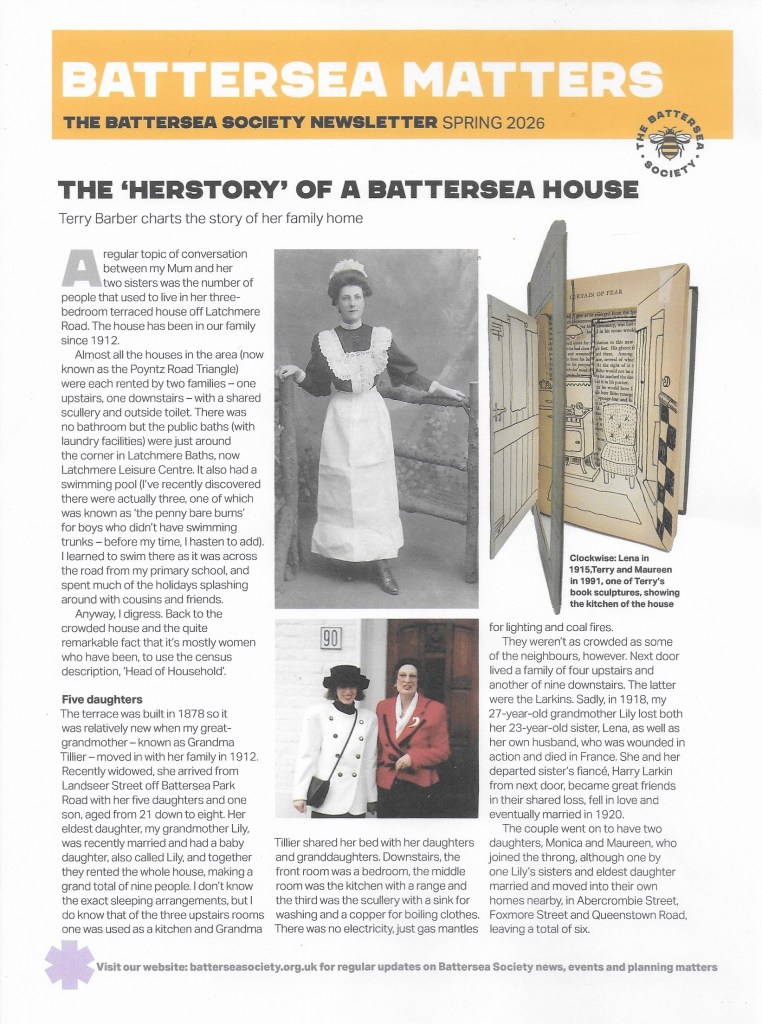
Terry Barber, the artist daughter of the Battersea Society’s former membership secretary, Maureen Larkin, has been charting the history of the house that’s been in her family since 1912, and has taken inspiration from it for her recent work.

A topic of conversation that cropped up regularly between my Mum and her two sisters was the number of people that used to live in her three-bedroom terraced house off Latchmere Road. Most (if not all) of the houses in the area (now known as the Poyntz Road Triangle) were each rented by two families – one upstairs, one downstairs – with a shared scullery and outside toilet. There was no bathroom but the public baths (with laundry facilities) were just around the corner in Latchmere Baths, now Latchmere Leisure Centre. It also had a swimming pool (I’ve recently discovered there were actually three, one of which was known as ‘the penny bare bums’ for boys who didn’t have swimming trunks – before my time, I hasten to add). I learned to swim there as it was across the road from my primary school, and spent much of the holidays splashing around with cousins and friends.

Anyway, I digress. Back to the crowded house and the quite remarkable fact that it’s mostly women who have been, to use the census description, ‘Head of Household’.

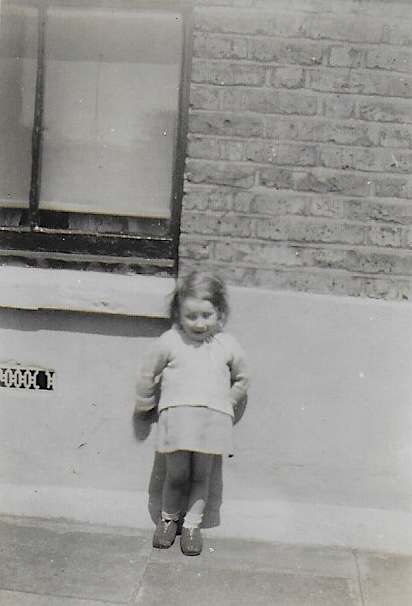
The terrace was built in 1878 so it was relatively new when my great-grandmother – known as Grandma Tillier – moved in with her family in 1911/12. Recently widowed, she arrived from Landseer Street off Battersea Park Road with her five daughters and one son, aged from 21 down to eight. Her eldest daughter, my grandmother Lily, was recently married and had a baby daughter, also called Lily, and together they rented the whole house, making a grand total of nine people. I don’t know the exact sleeping arrangements, but I do know that of the three upstairs rooms one was used as a kitchen and Grandma Tillier shared her bed with her daughters and granddaughters. Downstairs, the front room was a bedroom, the middle room was the kitchen with a range and the third was the scullery with a sink for washing and a copper for boiling clothes. There was no electricity, just gas mantles for lighting and coal fires.

They weren’t as crowded as some of the neighbours, however. Next door lived a family of four upstairs and another of nine downstairs. The latter were the Larkins. Sadly, in 1918, my 27-year-old grandmother Lily lost both her 23-year-old sister, Lena, as well as her own husband, who was wounded in action and died in France. She and her departed sister’s fiancé, Harry Larkin from next door, became great friends in their shared loss, fell in love and eventually married in 1920. The couple went on to have two daughters, Monica and Maureen, who joined the throng, although one by one Lily’s sisters and eldest daughter married and moved into their own homes nearby, in Abercrombie Street, Foxmore Street and Queenstown Road, leaving a total of six.

Trials and tribulations

Grandma Tillier paid her way with occasional ‘charring’ (cleaning), and also the ‘laying-out’ of local people who had recently died, while her two eldest daughters, Lily and Lena, went into service as parlour maids – jobs they were proud of as they were working ‘upstairs’. (A neighbour confided in me a few years ago that when he was a child, he used to call my grandmother ‘the posh lady’!). After her young husband was killed, Lily joined her younger sisters working at the Falcon pencil factory in York Road.

The trials and tribulations of a working-class family were kept very much to themselves, and certain events were rarely talked about, including unemployment; Grandma Tillier’s brother’s suicide over gambling debts; the commital of her only son from the workhouse infirmary to the ‘mental hospital’ in Epsom; and her own court appearance over rent arrears. Apparently, when she went to the authorities for help to pay the rent, they asked her if she had any furniture; when she answered ‘yes’, she was told to come back when she had sold it and had nothing left. 

In 1930, Maureen’s father Harry, who was a shop assistant at Milton Syer builders merchants in Peckham, increased his and wife Lily’s rental from two rooms to three, paying nine shillings and sixpence per week. The third room was the upstairs front bedroom where my Mum, Maureen, was born. Grandma Tillier continued to live in her rented bedroom and kitchen until she died in 1948, followed a couple of months later by her son-in-law Harry. My grandmother went back to work again, helping a friend with housekeeping duties for a family in Burgess Hill. Monica and her husband Peter had a son later that year and moved into a house in Sabine Road, and Maureen left school, aged 15, to start work as a secretary to help pay the rent now it was just her and her Mum at home. Until I came along, that is, and then there were three. When my grandmother died in 1971, Maureen took over the rental and once I had started work she was able to buy the house in 1975 from the landlord – for the princely sum of £2,000. With a home improvement grant from the council we finally had the luxury of a bathroom and she continued to live there for the rest of her life.

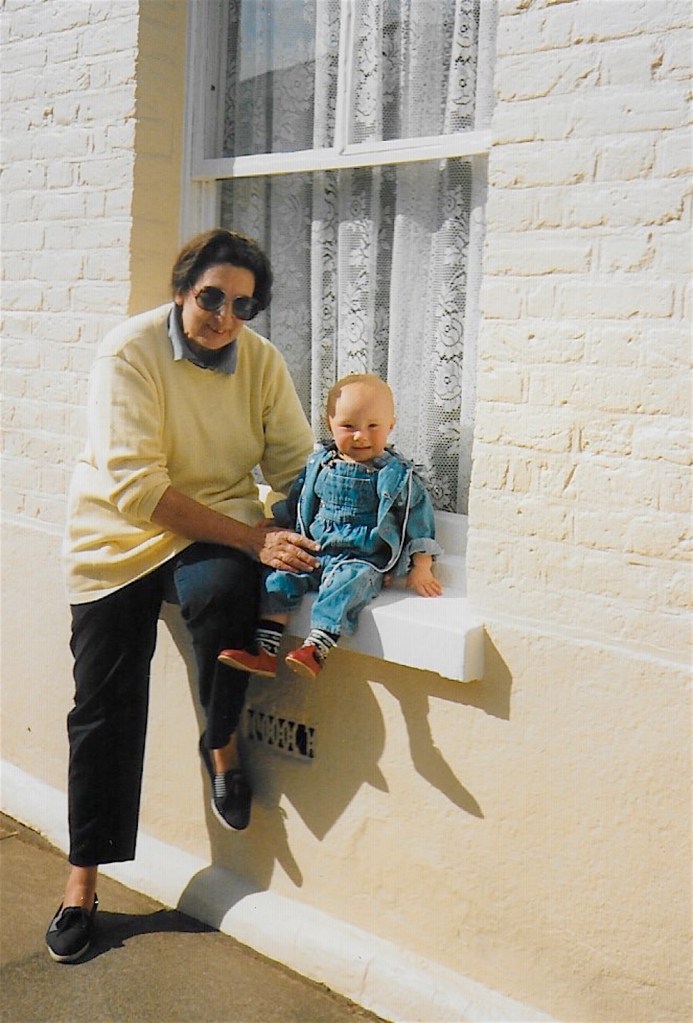
With such a long family history it would have been difficult to let the house go when Mum died, but luckily my own daughter, Madeleine, felt the same way and is very proud to be the fifth generation of dynamic women to hold the keys. She is a successful travel journalist with many awards to her name. The house has now been extended and these days has more than enough room to swing a cat – two large Maine Coons to be precise – who live there with her and her friend Mel. And so, the story continues…

Terry’s mother, Maureen Larkin, was for many years the Battersea Society’s membership secretary. Terry is an artist and has taken inspiration from the house for her recent work.
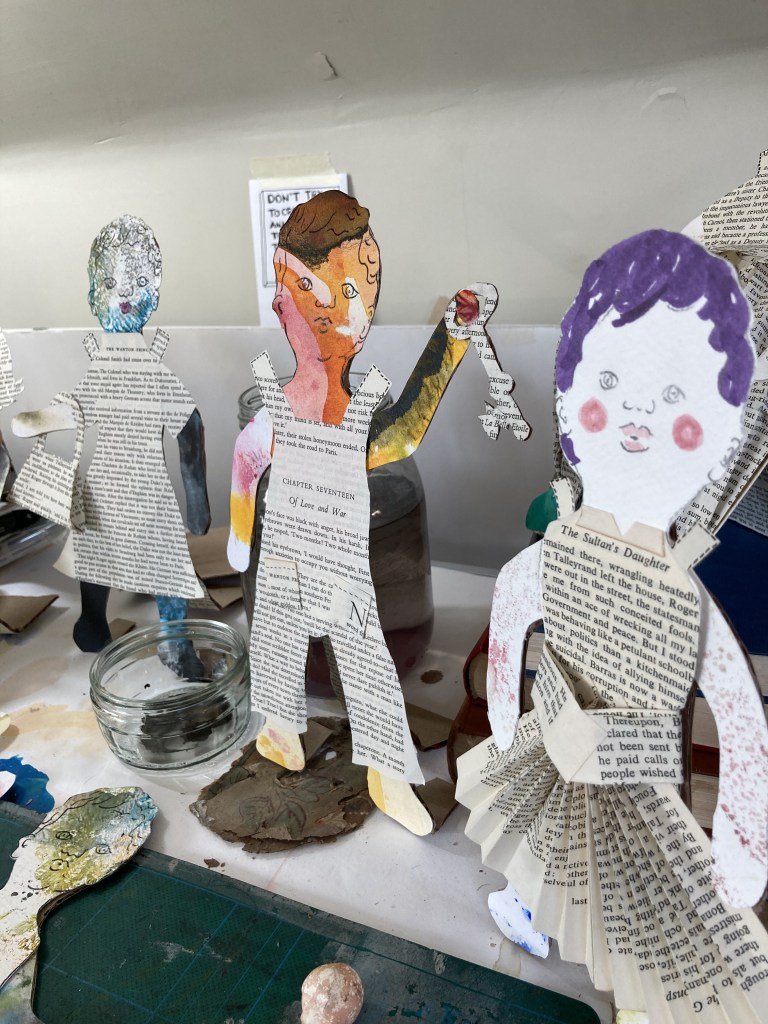
The Wanton Princesses

Since uncovering several objects deep under the stairs in my old family house during renovations – some hidden for maybe a hundred years or more – I’ve been using these as inspiration for my latest body of work. 

These objects – among them a china doll, key, pink plastic deer, walking stick, button, wooden pegs and framed wedding photograph of my grandparents, none of which I had seen before – have variously been witness to two world wars, births, deaths, mischievous children and the ups and downs of five generations of the same family in this house. They could even be thought of as household deities, like the ancient Roman tradition of lares familiares, looking after the welfare of the home and the people in it from their involuntary shrine in the cupboard under the stairs. 

A permanent feature on the living room dresser since the 1960s, the collection of ‘Book Club’ books that belonged to my Mum have found their way into much of the work in this exhibition (even though cutting and tearing books initially feels like sacrilege). I often use non-traditional or recycled materials as they offer the chance to work freely and experimentally. They also have their own intrinsic appeal, and can spark new ideas or directions with an unexpected printed word, phrase or design – hence the Wanton Princesses, a chapter heading on a randomly selected page torn from a Dennis Wheatley book. I love it when that happens!

Breathing Space, a Six Artists exhibition at Nunnery Gallery, 18-24 September 10am-4pm (closed Mondays). Private View: Friday 20 September 6-9pm

IN THE FLESH

A Six Artists exhibition at Nunnery Gallery, Bow Arts, 181 Bow Road, E3 2SJ

20-26 September 2023 (open Tues-Sun 10am-4pm)

Private View: Friday 22 September 6-9pm

In this exhibition at Nunnery Gallery in East London, six artists with varying practices explore subjects including the body and health, decaying natural and industrial structures, memory and forgotten histories, and imagined landscapes. The artists’ wide variety of approaches to these subjects makes for a dynamic conversation between the works. Intent on capturing both emotional and physical sensation, each artist’s careful selection and manipulation of materials creates a visceral response to the world and their experience of it. 

The artists are a multidisciplinary group with practices ranging from painting and printmaking to sculpture and assemblage, collage, animation and portraiture. Their diverse histories, backgrounds and experiences bring an exciting breadth to this group exhibition, where the artworks complement and cross-reference each other creating a dynamic and coherent body of work. 

The Six Artists collective comprises Terry Barber, Caroline Ingham, Catherine James, Gill Lucas, Octavia Milner and Tabitha Powles, who met on the 2018/19 Fine Art Mentoring Course at Morley College directed by Erika Winstone, who has also curated this show. Their first plans to exhibit together in a physical gallery were disrupted by the pandemic; undeterred and thanks to the skill and dedication of Catherine James, they instead created an online show in a virtual gallery space. This is their first exhibition together ‘in the flesh’.

Terry Barber, Untitled (Promise 1), ink, watercolour and graphite, 2023

EXHIBITION: INTERRUPTIONS

INTERRUPTIONS
8-13 June 2021

​Featuring a diverse range of work encompassing painting, sculpture, installation, video and printmaking, this exhibition has been conceived and implemented by 11 artists who have all taken part in the Fine Art Mentoring course run by Erika Winstone at Morley College.

Participating Artists:

Cass Breen, Louise Hardy, Nell Martin, Bernadette Enright,
Katherine Rose, Anjum Moon, Abigail Elverd, Terry Barber,
Helen Pavli, Yasmin Noorbakhsh, Catherine James.

The course aims to form a bridge between college and gaining confidence through forging connections and a sense of community to practise and thrive as independent artists. An important part of this journey involves working together to independently organise a group exhibition. This year has been especially challenging in many ways and the show has been postponed twice since September due to lockdowns. However, the success is partly due to how the mentees have continued supporting each other through online meetings some ten months after finishing the course. 

Erika Winstone, who has curated the exhibition, comments: ‘The work in this show demonstrates the rich achievements of each artist individually, as well as the benefits of alternative models of learning to increase access to a peer group inclusive of a wide range of histories, background and experience. I congratulate each mentee on this rich, thought-provoking and exciting exhibition. 

‘I look forward to seeing their continuing journeys as artists and further work in a second online show in July. 

‘Thanks to Terry Barber for her evite design and masterminding of the catalogue, and to Catherine James for designing the online exhibition. Also very special thanks to the fantastic input of the following visiting artists for their invaluable contributions: Rosalind Davis, Justin Hibbs, Daniel Howard-Birt, Sara Knowland, Barbara Nicholls, Anne Ryan and Susan Sluglett.’ 

Opening hours:
Tue-Sat 12-7pm
Sun 10:30am – 4pm
Measures will be in place following government Covid-secure guidance.

The online exhibition launches on 6 July; see the group’s Instagram page for further details and also any changes to arrangements to comply with latest government advice: @mfam.interruptions

My sweet gourd

Anthea Hamilton: Tate Britain Commission 2018

IMG_7113
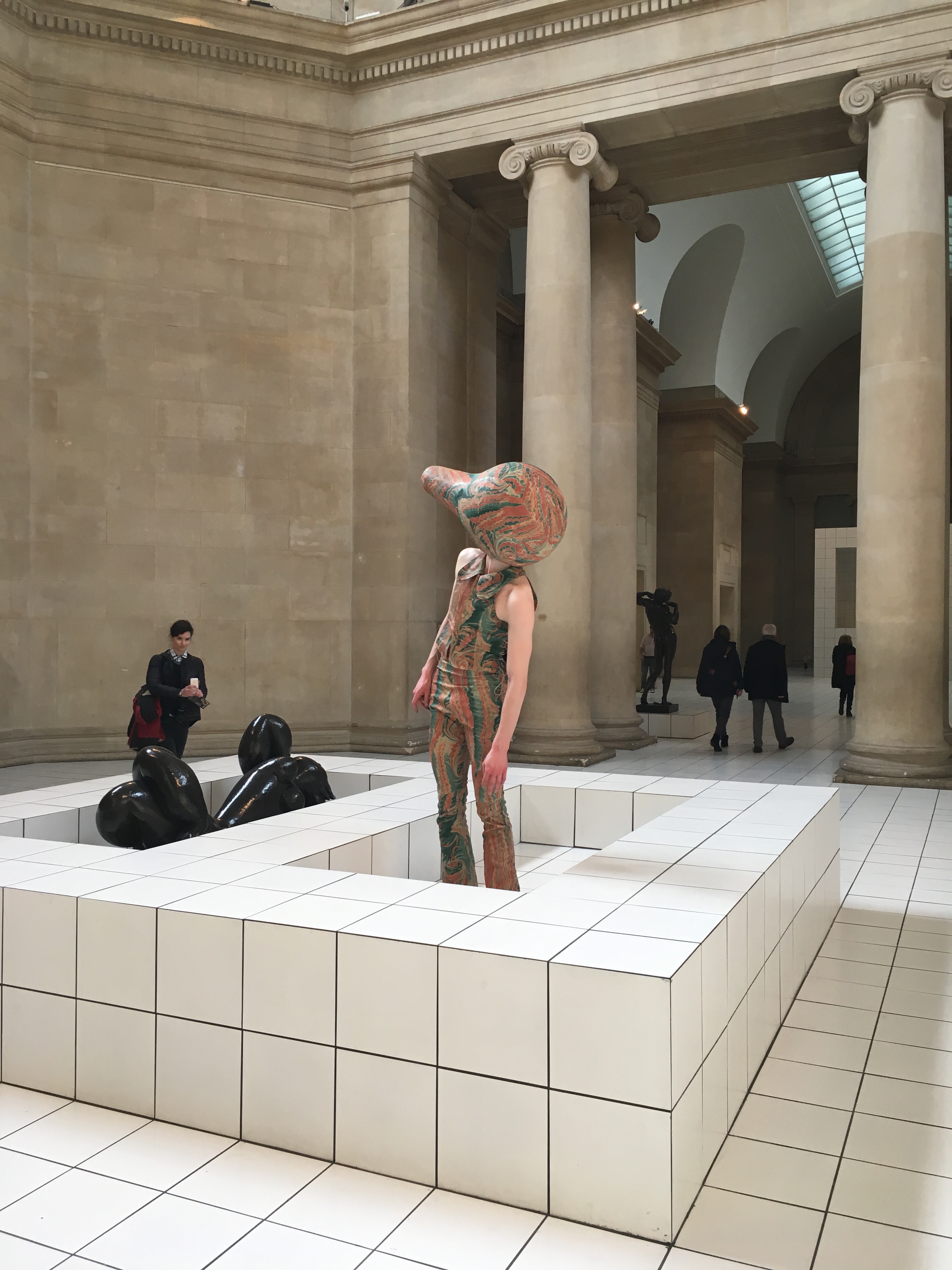
The Squash, Anthea Hamilton, 2018

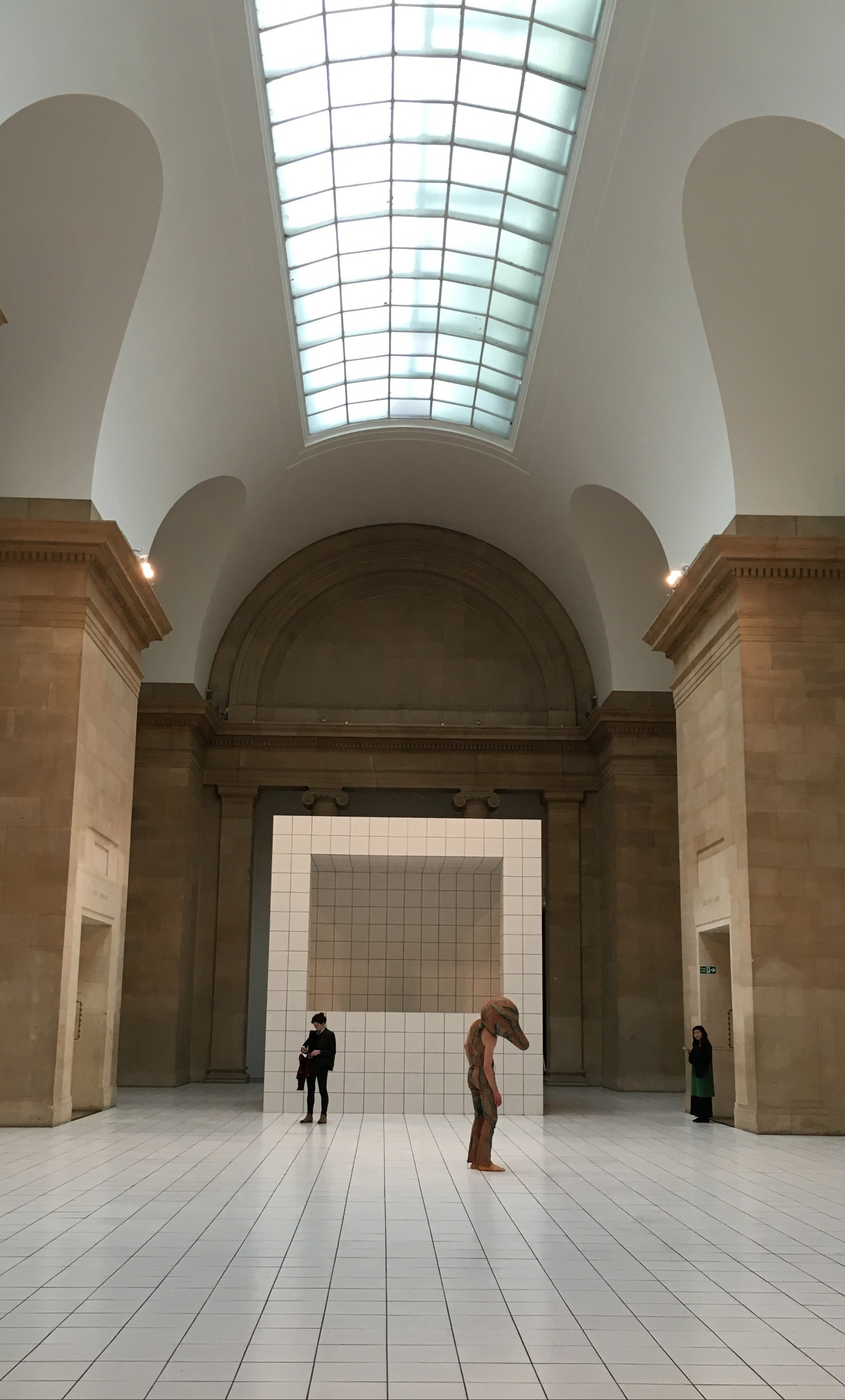
I arrived in the Duveen Galleries at 1.30pm, eyes peeled for someone dressed as a vegetable. It was eerily empty and clinical, save for a small ceramic pumpkin on a shelf with a sign ‘Gone to lunch’. I suppose even a squash needs a break.

The entire floor of the Duveen has been covered in white tiles, which are also used to form plinths, platforms and what look like baths or plunge pools – the kind you might see footballers or rugby players sharing post-match. This is the pristine, almost laboratory-like setting for Hamilton’s performer to inhabit, wearing their choice of gourd-inspired costume for the day – apparently there are seven options, each one inspired by the patterning on a variety of squash or pumpkin.

When The Squash returned from lunch, it struck me how small he looked in the huge gallery – a diminutive, green-and-orange, pointy-nosed human-vegetable hybrid. Moving slowly, gracefully and deliberately, the character examined his surroundings, rambling vine-like over, in and around the various structures, much like a pumpkin growing in a veg patch. Here, though, The Squash is an alien, tentatively trying out his new environment, exploring what it means to be other-worldly. The Tate sculptures selected by Hamilton to co-inhabit the space appear dumbstruck amid the performance: a lumpen, static audience for the ever-moving Squash. However, Leighton’s The Sluggard and Laurens’ reclining Autumn set up a real dialogue with the artwork, their languorous poses reflecting the performer’s movements. It’s surprisingly mesmerising and rather beautiful.

Anyway, back to that sign. If it was up to me, it would have read ‘Gone for a pea’. (And that’s just one of the reasons why, unlike Anthea Hamilton, I’ll never be nominated for the Turner Prize.)

img_7103-e1523662559293.jpg
The Squash, Anthea Hamilton, 2018

SaveSave

Remembering sunshine, sculpture and stunning scenery in Shoreham

As I write, the sun is shining and the view from my window suggests that spring has finally arrived – the daffodils are dancing, the birds are busying and the trees are budding. The grass also needs cutting. Cue a sudden urgency to update my website.

The upturn in the weather has brought back memories of a sweltering summer day at the Shoreham Sculpture Trail in June last year. As well as being a gift for alliterative blog post headings, it was a visual feast.

This wasn’t your average village affair to raise funds for repairs to the local church, even though that was the ultimate aim. No, this was an ambitious art trail featuring 80 or so members of the London Group – a long-established group of artists whose founder members included the 19th-century painter and printmaker Samuel Palmer, a one-time resident of the pretty Kent village in the Darent Valley.

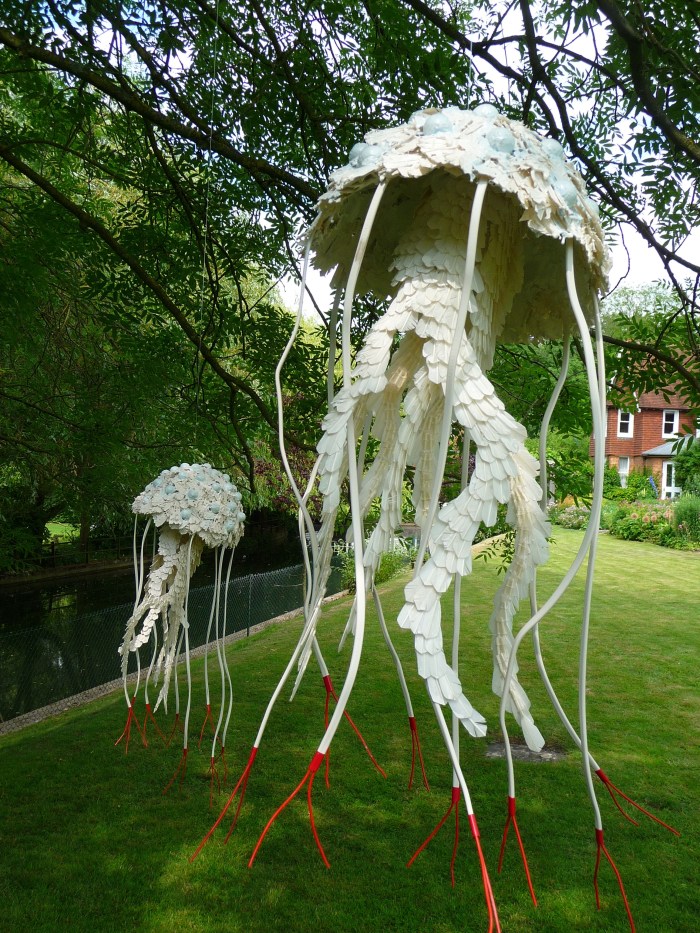
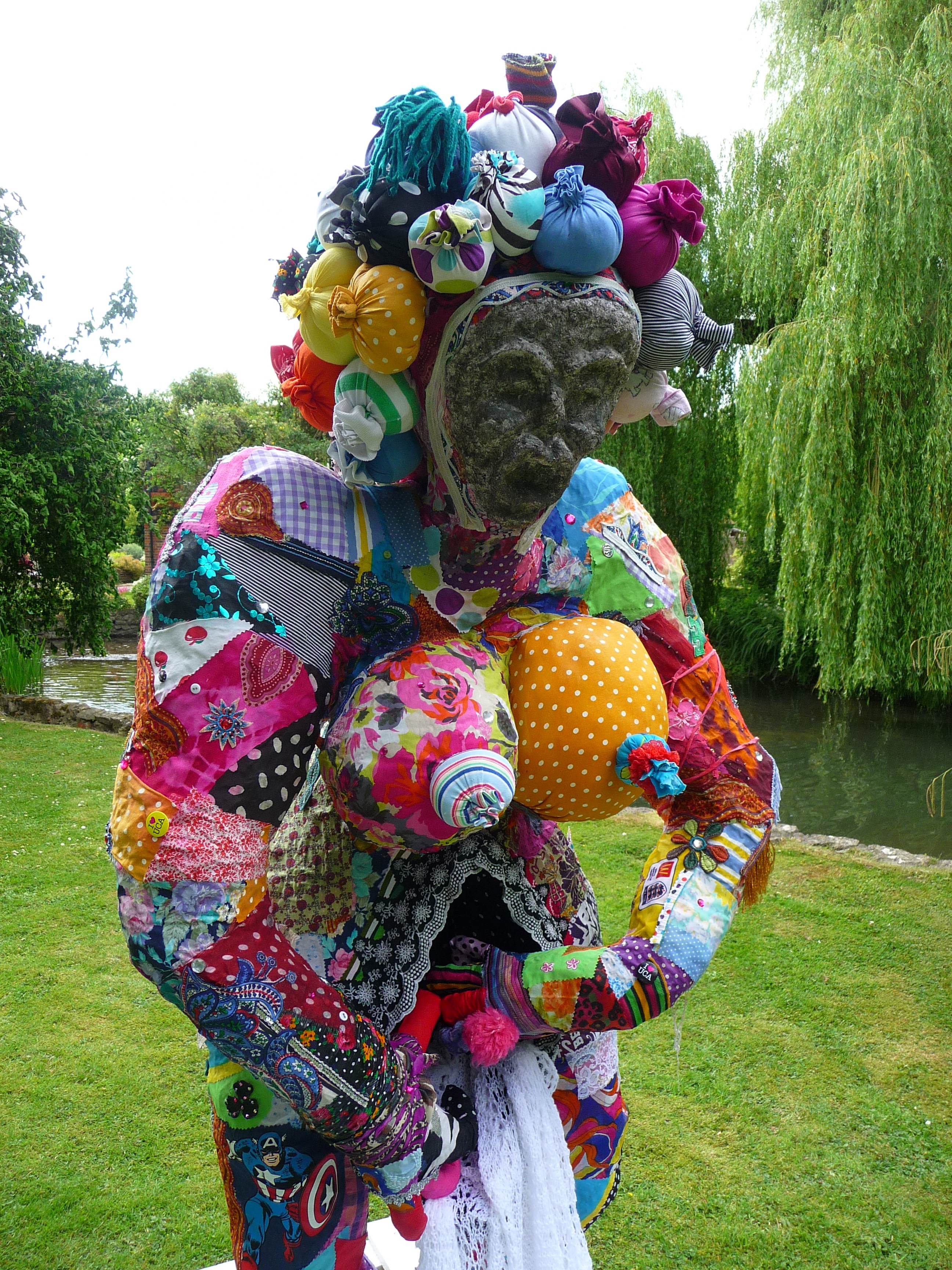
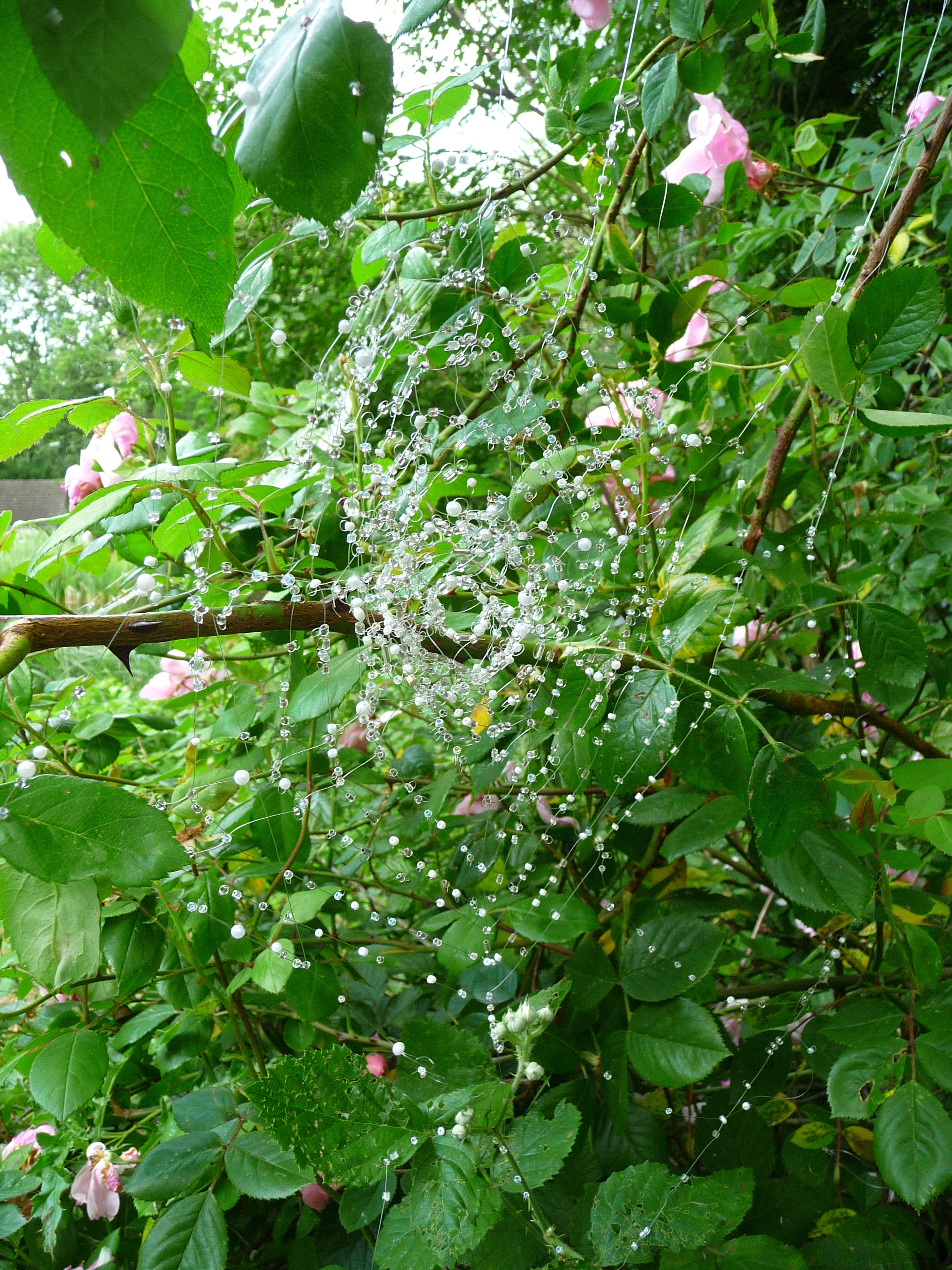
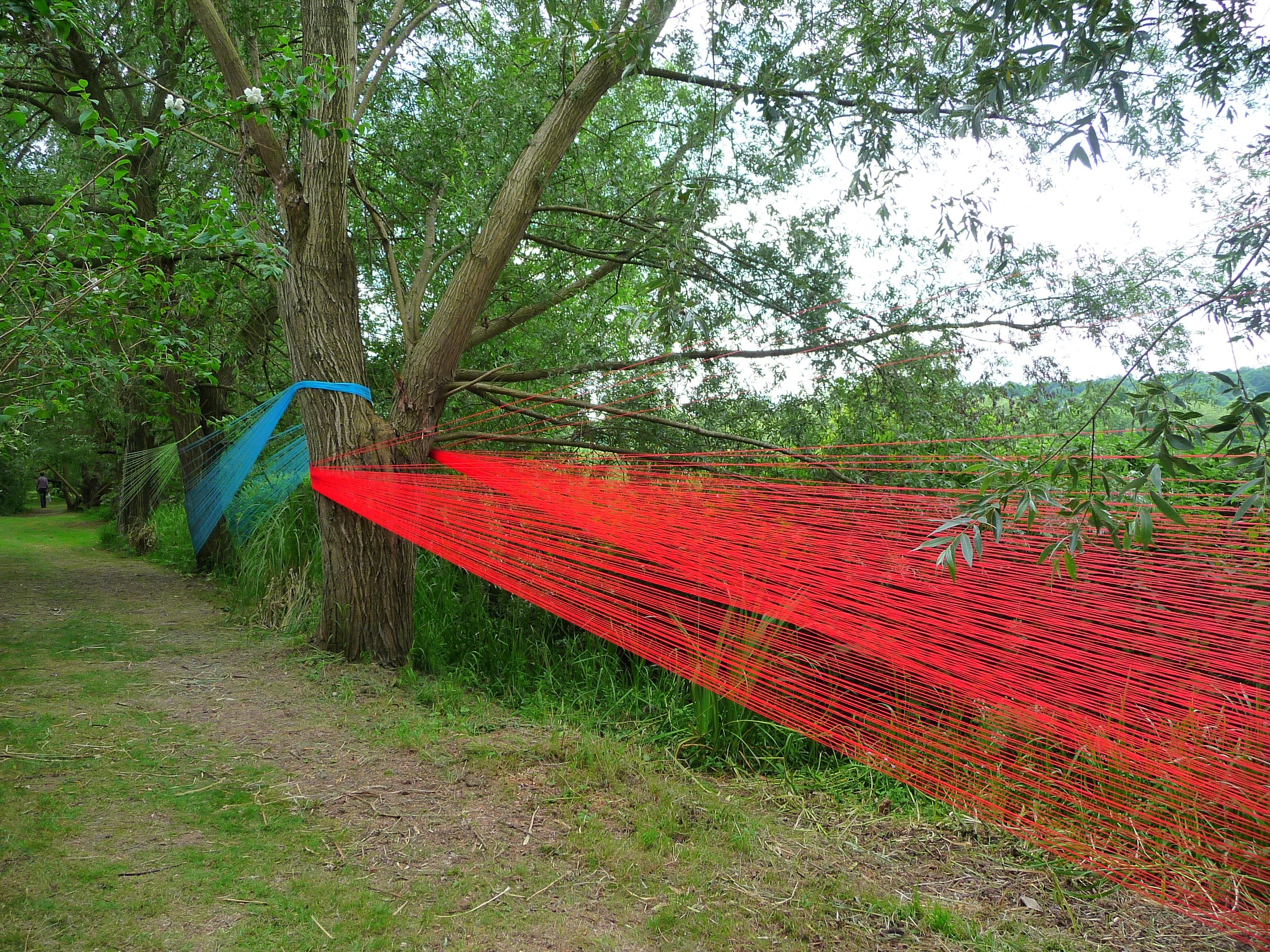
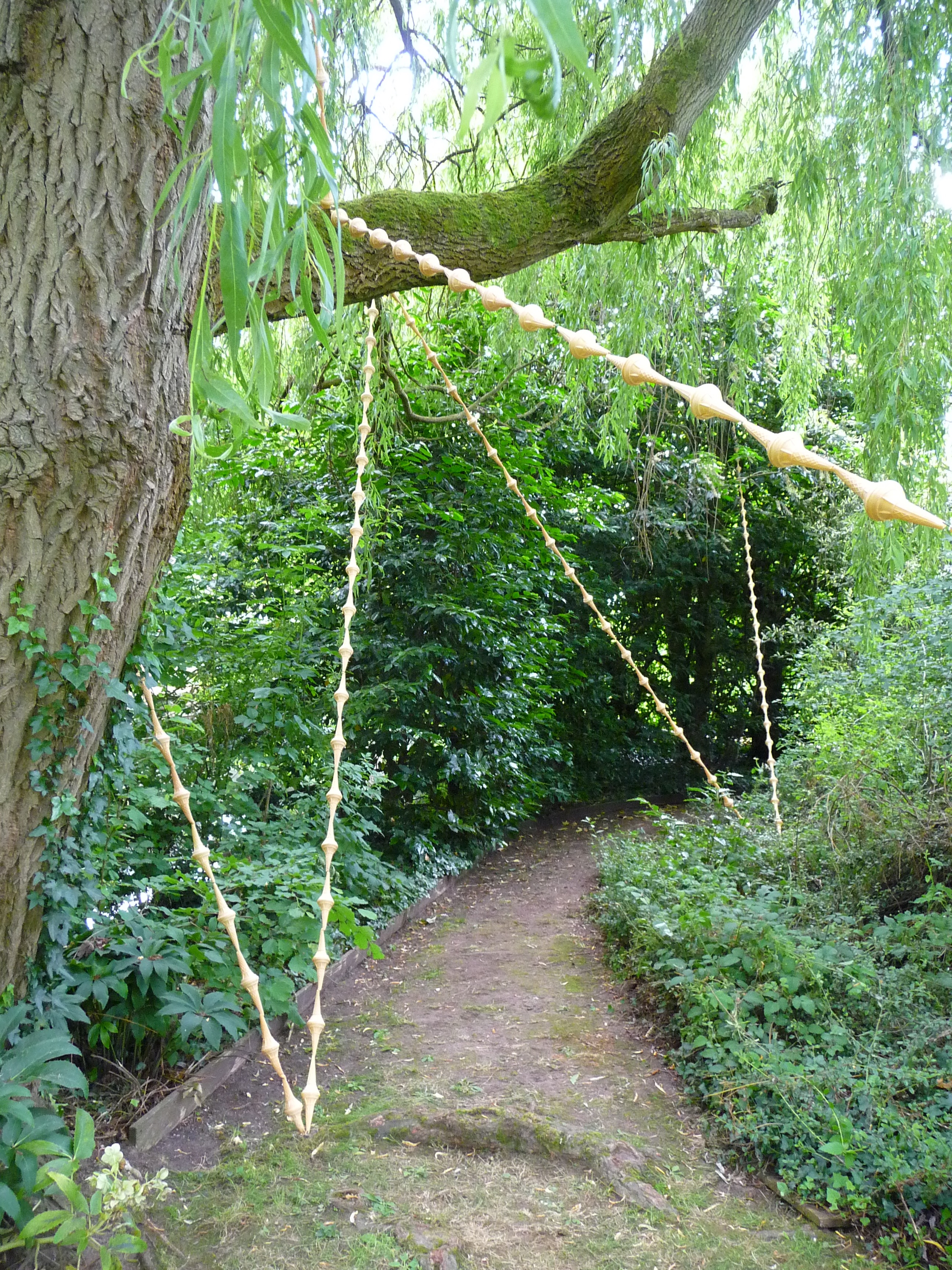
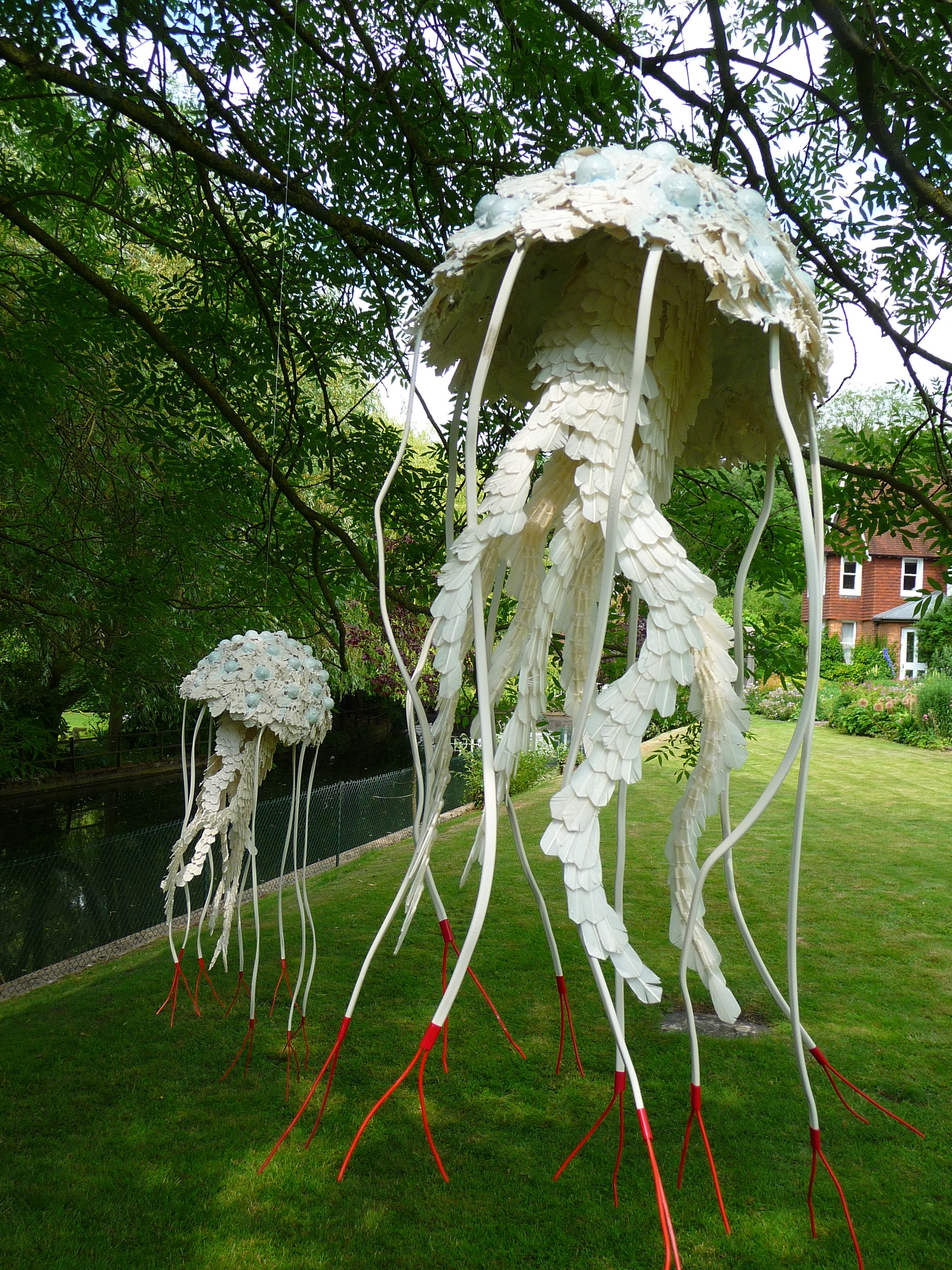
From interventions with the landscape, such as pearl-encrusted spiders’ webs, strings of ice-cream cones and coloured thread winding through and around trees, to incongruous creatures such as a group of shuttlecock-and-cable jellyfish and a patchwork figure apparently disembowelling itself on a neatly manicured lawn, the work was diverse, surprising and thought-provoking. I’m keeping my fingers crossed and an eye on the London Group website for any news of a repeat performance this year.


Tisna Westerhof
Tisna Westerhof

P1040147
Franny Swann

P1040152
Martin Heron

P1040170
Matthew Kolakowski & Jane Eyton

P1040175
Jane Eyton

P1040189
Fiona MacDonald

Interview with a textile artist

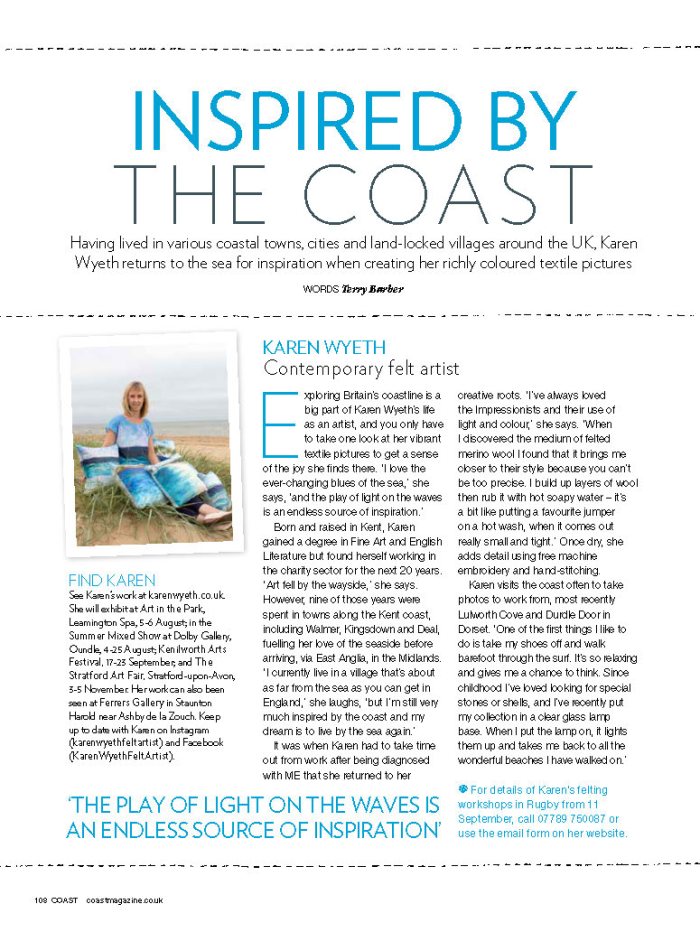
One of the perks of being a journalist/artist is that sometimes my roles happily converge. So when I’m commissioned to interview an artist I get to pick their brains about how they work, what inspires them and what materials they use and how. And then I get the satisfaction of seeing it all come together in a glossy magazine. Win-win.

Here’s my interview with textile artist Karen Wyeth, published in the October issue of Coast last year.

P098_COAST_OCT17_INSPIREDBY_Page_1

P098_COAST_OCT17_INSPIREDBY

(Copyright Coast magazine)

UPCOMING EXHIBITION ‘NINE’ SHOWCASES DYNAMIC NEW WORK BY ARTISTS FROM KENSINGTON & CHELSEA COLLEGE

Picker

Private View: 6-9pm, 17 May 2017
Exhibition: 18-20 May 2017 Seminar: 2-5pm, 20 May 2017
Place: 508 Kings Road Art Gallery, Kings Road, Chelsea SW10 0LD

Students from the HND Fine Art course at Kensington & Chelsea College will be taking over 508 Kings Road Art Gallery in Chelsea to present their end-of-year show to art lovers from across the capital.

Featuring a range of work including painting, sculpture, installation and photography, the exhibition promises an exciting glimpse into the artistic practices of these emerging artists as they complete the equivalent of their second year of a BA degree.

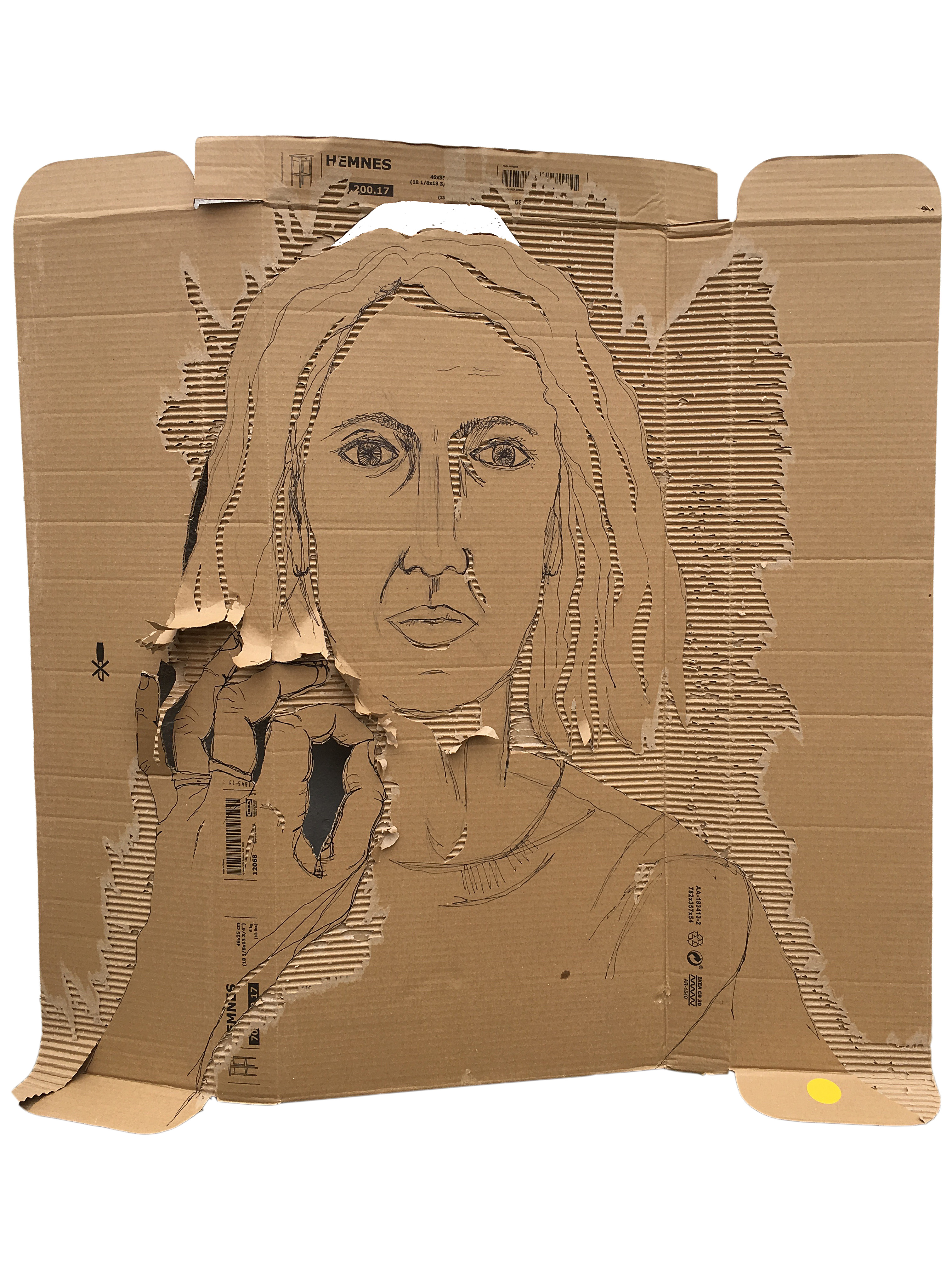
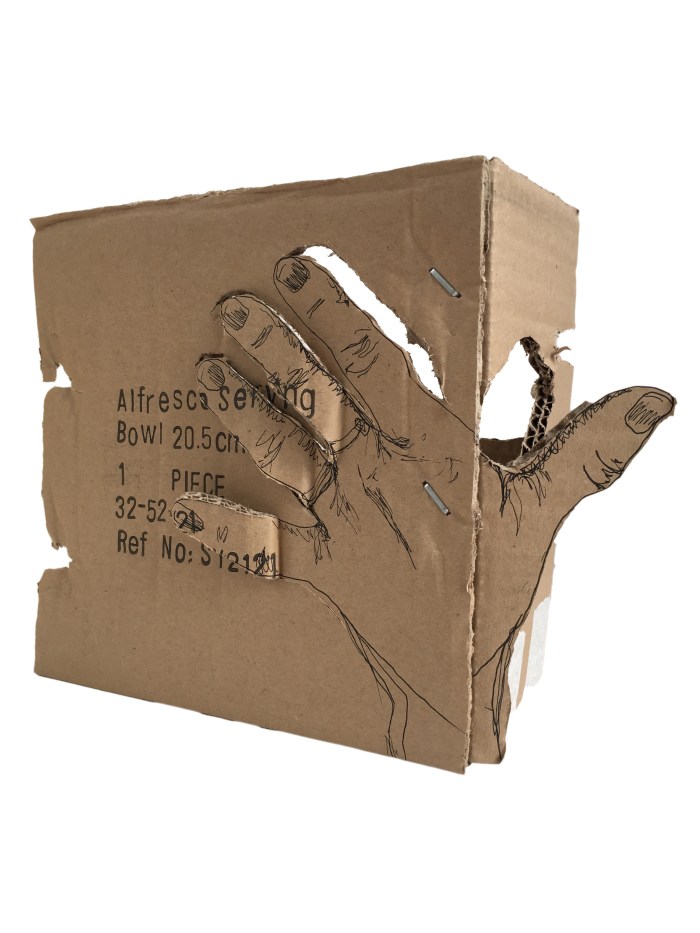
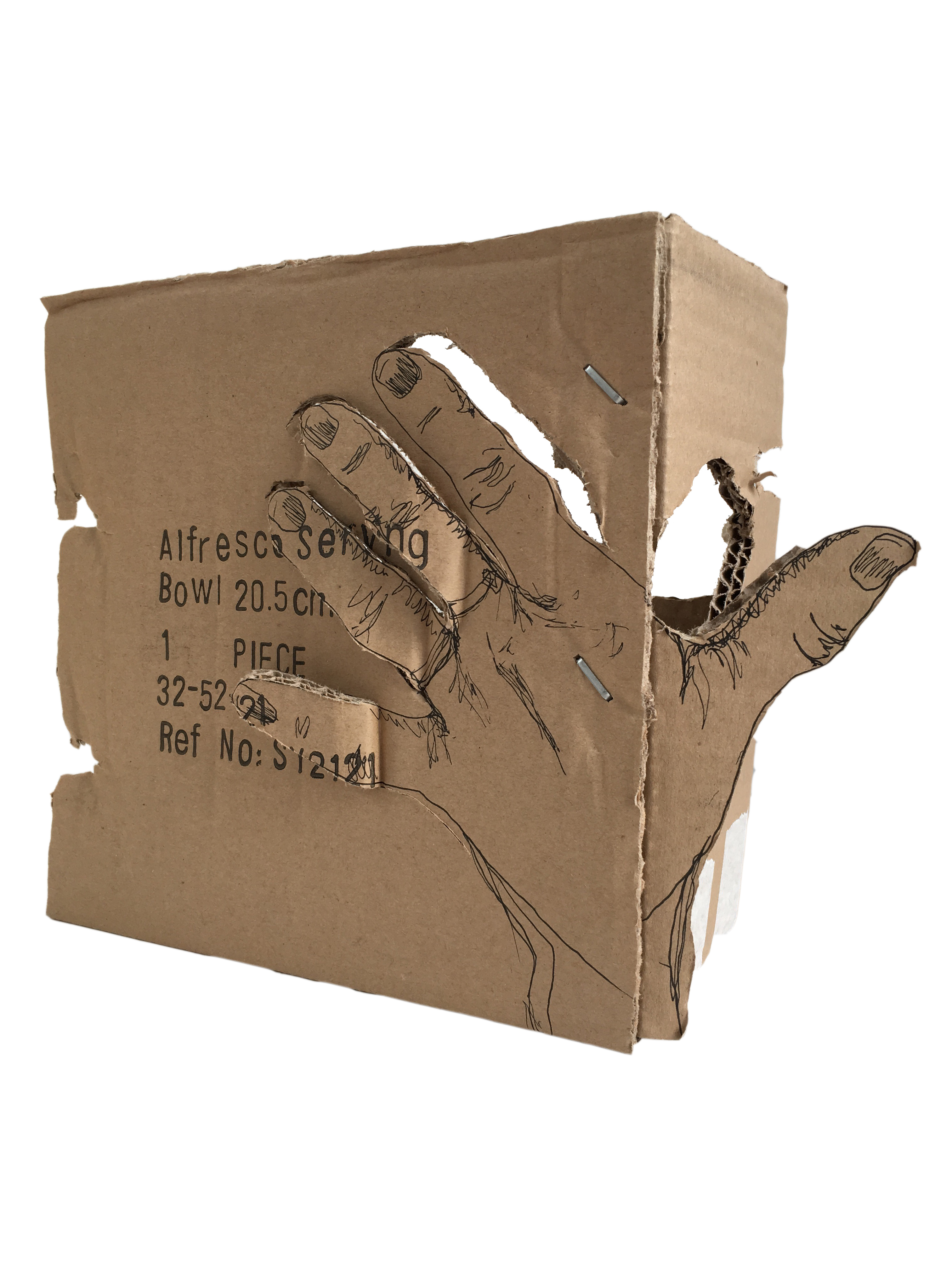
From Charlotte Fraser’s colourful yet poignant oil paintings to Louise Richards’ wearable sculptures, and from Alex Purcell’s message-heavy collage to Terry Barber’s sculpted cardboard installation, the work will provoke thought as well as surprise and entertain. Many of the exclusive artworks will also be for sale. There will be a seminar on the last day of the show, Saturday 20 May, from 2-5pm, when visitors will have the chance to join in a discussion of the artists’ work and ask questions.

The exhibiting artists are: Terry Barber, Charlotte Fraser, Felix Jude, Maie Moussa, Alex Purcell, Louise Richards, Nazanin Sarabi, Katherine Skinner and Natalie Wells.

Course director Jane Eyton says: ‘This will be one of the strongest HND Fine Art shows to date. The students have worked extremely hard this year and have shown real progression, independence and achievement in their ideas, materials and promotion of their creative practice. Come and support them at the 508 Gallery, situated in an extremely central location, to see their new work.’

Notes to editors:  The NINE artists are studying HND Fine Art at Kensington & Chelsea College, the equivalent of the second year of a BA (Hons) degree. They progressed to this from HNC Fine Art. The college also runs a Fine Art BA (Hons) top-up, validated by London South Bank University, which many of the featured artists aim to progress to in order to gain their full Fine Art BA (Hons) degrees. For further details about the college and its courses, visit kcc.ac.uk or email info@kcc.ac.uk.

And now, the end is near…

I can’t believe how fast my year of HND study has been going. The final exhibition is just over a week away, and it’s all hands on deck to get this show on the road (Kings Road, in fact, at 508 Kings Road Art Gallery). It’s all part of the course for us group of nine students to find and book the venue, organise the show and private view, and then publicise it. Oh, and to develop and produce some amazing work to go in it, of course.

I’m in charge of publicity, so forgive me for the shameless plug in my next article. I thank you.Handy


A Mach made in heaven

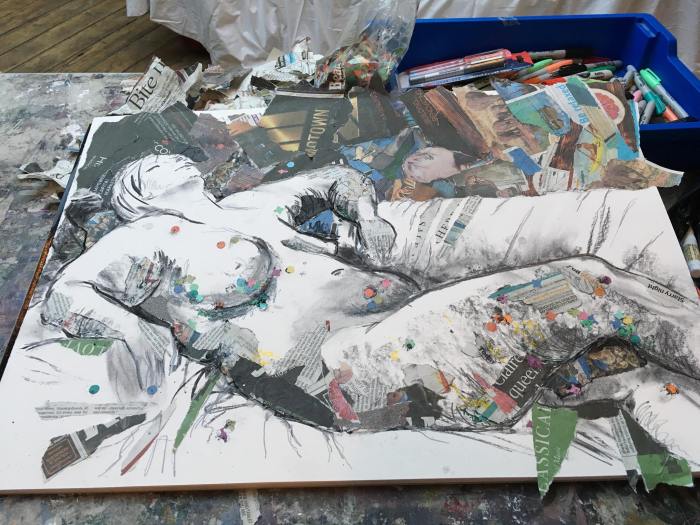
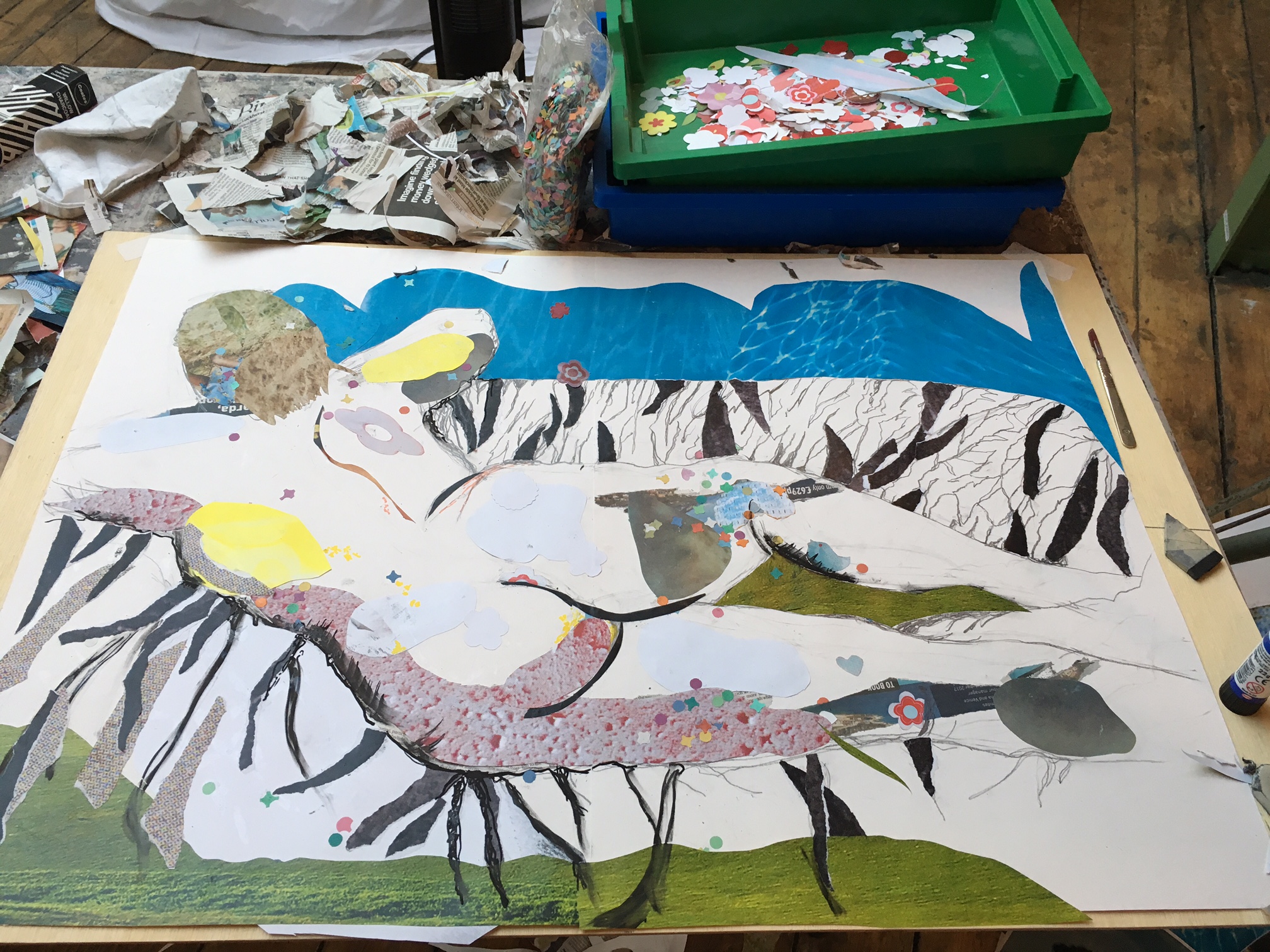
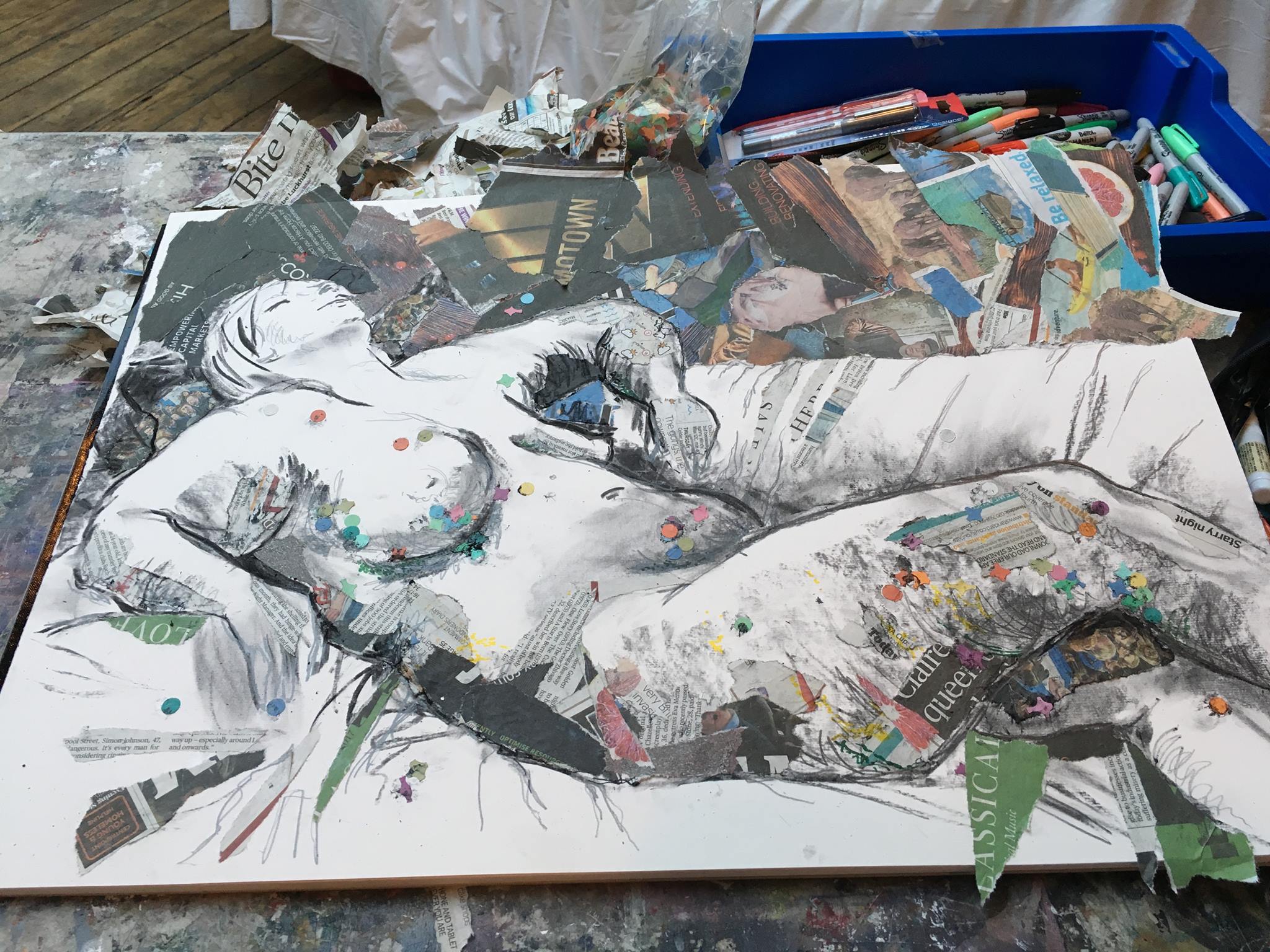
It’s not every day that you get to rummage around in your hero’s drawers, if you’ll pardon the expression. But as a participant in one of Royal Academician David Mach’s first Drawing & Collage masterclasses, for three days I was let loose among his vast hoard of collage materials to add to and develop the drawings I’d made in his studio, working from the life model.

Feeling like a kid in a sweetshop, it was difficult to choose from the myriad papers carefully categorised under tantalising headings such as blue skies, beach, ice/snow and water, as well as the less savoury ones labelled hellfire, fat, and falling folk. As someone who loves a bit of colour-coordinated organisation, it was a double whammy.

It was a long weekend of uninterrupted drawing and collage heaven, with lots of advice, creative development ideas and encouragement from David. The sessions were regularly punctuated by tea and biscuits (ginger thins, in case you were wondering) and anecdotes from the artist’s long and successful career. In short, it was challenging, inspiring, motivating… and a lot of fun.

Mach masterclass-2

Mach masterclass-1

*Find out more about David Mach and his masterclasses at davidmach.com and check out upcoming open studios events at havelockwalk.com